
The Talent Engine: How RPO Powers Agile Growth and Strategic Talent Acquisition
The strategy is approved, the budget is signed, and the org chart is ready. Then the hiring starts, and everything slows down. Requisitions sit open for months, hiring managers juggle interviews on top of their day jobs, and the people already on the team carry the extra load.
That’s the Recruitment Bottleneck, and it quietly stalls more growth plans than any market downturn. Modern RPO solutions treat hiring as infrastructure, not a series of one-off transactions. With a dedicated recruitment team embedded in your process, talent acquisition becomes a predictable, scalable engine. Here’s how that engine works.
- Nearly 70% of HR professionals still face challenges recruiting for full-time roles.
- Agency fees commonly run 15 to 25% of each hire’s first-year salary.
- RPO replaces per-hire fees with one flat monthly rate and full pipeline visibility.
- A dedicated RPO team can be sourcing candidates within about two weeks.
The Recruitment Bottleneck

Internal hiring models are built for steady demand. Growth rarely arrives that way.
Roles Open Too Long
A new product line, a funding round, or a new site can double hiring demand overnight. Lean talent teams can’t source, screen, and schedule at that pace. According to SHRM’s 2026 Talent Trends research, drawing on more than 2,000 HR professionals, nearly 70% still face challenges recruiting for full-time positions. In Australia, the Australian Bureau of Statistics counted 325,000 job vacancies in August 2026.
Current Teams Carry the Load
Every open seat lands on someone else’s desk. Overtime climbs, morale dips, and the risk of losing more people rises. The same SHRM research found 42% of HR professionals struggled to retain full-time employees over the past year. A slow hiring process doesn’t just delay growth. It erodes the team you already have.
Growth Plans on Hold
When critical roles stay vacant, launches slip, revenue targets drift, and leaders lose confidence in the plan. Agencies can fill the occasional hard role, but at 15 to 25% of first-year salary per hire, costs balloon for companies that hire regularly. Building a local talent team is expensive too, with in-house recruiters often costing US$70,000, A$85,000, or £35,000 and up before benefits.
Transactional Staffing vs Strategic RPO
Agencies sell placements. An RPO partner builds hiring capacity. The difference shapes everything from cost to candidate experience.
| Transactional Agency | Strategic RPO |
|---|---|
| Fee per placement, often 15 to 25% of salary | One flat monthly rate, however many people you hire |
| Recruiters split across many clients | Recruiters dedicated to your roles and brand |
| Black-box sourcing | Every touchpoint logged in your ATS |
| Candidate data stays with the agency | Talent pools stay in your systems |
| Reactive, role by role | Proactive pipelines built ahead of demand |
From Cost Center to Growth Engine
When hiring runs on per-placement fees, every new role is a fresh negotiation and a new invoice. An RPO model turns that variable spend into fixed, predictable infrastructure. Your recruiters learn your culture, your hiring managers, and your must-haves, and that knowledge compounds with every search.
Capacity That Flexes With Demand
| Hiring Moment | RPO Response |
|---|---|
| Steady replacement hiring | One embedded recruiter or sourcer |
| Funding round or expansion | A full end-to-end team led by a senior recruiter |
| New site or high-volume campaign | A project team scaled to the campaign |
| Hiring slowdown | Scale back, or shift focus to talent pools and employer branding |

Three Pillars of a Modern RPO Framework
A high-performing talent engine rests on three capabilities working together.
Sourcing
- Active and passive talent
- LinkedIn Recruiter and Boolean search
- Personalised outreach
- Multi-board job ads
Screening
- CV review against your criteria
- Structured phone screens
- Skills test coordination
- Interview scheduling and updates
Analytics
- Weekly pipeline reports
- Source-of-hire tracking
- Clean ATS records
- Talent pool maintenance
Pipelines Built Before You Need Them
Great candidates are rarely browsing job boards. Your RPO team finds active and passive talent through LinkedIn Recruiter, Boolean search, and talent communities, then reaches out with personalised messages that get replies. Over time, those conversations become warm talent pools ready for your next opening.
Candidate Experience That Protects Your Brand
Every candidate who applies is forming a view of your company. Your recruiters run structured screens, coordinate interviews across calendars, send reminders, and keep every candidate informed, so nobody falls through the cracks. Hiring managers only meet people who genuinely fit.
Structured Process, Measured Results
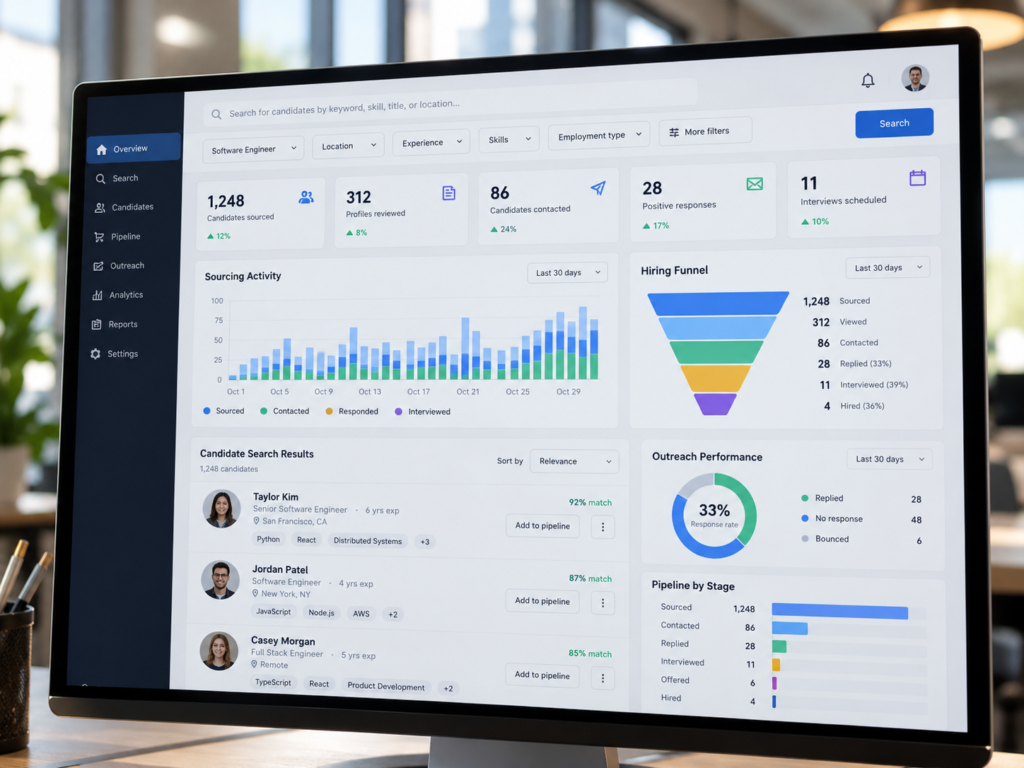
Transparency is what turns recruiting into a managed process. Here’s what a healthy pipeline can look like for a single role.
| Pipeline Stage | Candidates |
|---|---|
| Sourced | 240 |
| Contacted and engaged | 96 |
| Phone screened | 34 |
| Shortlisted to you | 8 |
| Interviewed | 4 |
| Offer accepted | 1 |
Metrics That Matter
An RPO partner should report on the numbers your leadership team cares about.
Time to Hire
Days from first contact to accepted offer, by role and stage.
Cost per Hire
Total recruiting spend divided by hires, without placement fees.
Source of Hire
Which channels actually produce the people you hire.
Pipeline Conversion
Where candidates drop off, so bottlenecks get fixed early.
Your recruiters work inside the hiring tools you already use, including:
- LinkedIn Recruiter
- Greenhouse
- Lever
- Workday
- Bullhorn
- JobAdder
- Workable
- BambooHR
- SEEK
- Indeed
- Reed
- Calendly
“Every unfilled role is a growth plan waiting on a hiring process.”
An Extension of Your HR Team
UpraisIT recruiters don’t work at arm’s length. They join your talent function, adopt your employer brand, work inside your ATS and inbox, and follow your hiring process and compliance standards. Candidates experience your company, not a third-party agency.
| Your RPO Team | Your Hiring Managers and HR |
|---|---|
| Sources, screens, and shortlists | Run final interviews |
| Schedules interviews and collects feedback | Make every hiring decision |
| Prepares offers and reference checks | Approve and extend offers |
| Prepares right-to-work documents | Complete final verification |
Three Ways to Engage
| Model | Best For |
|---|---|
| Embedded Recruiter | Lean in-house teams needing extra sourcing and screening capacity |
| End-to-End RPO | Scaling companies handing over the full lifecycle |
| Project and Agency Support | Hiring surges, new sites, volume campaigns, or white-label agency work |

Why UpraisIT
Recruiters Who Know Your Markets
Philippine recruiters work with LinkedIn Recruiter, modern ATS platforms, and Western hiring practices every day. English is an official language, and the country ranks 28th globally in the EF English Proficiency Index. Recruiters are trained on the job boards, salary expectations, and hiring norms of your market. Each candidate passes:
- A sourcing exercise
- An English assessment
- A background check
- Your interview before joining your team
Fully Managed Talent Infrastructure
UpraisIT handles recruitment, HR, payroll, equipment, and account management. Your team delivers weekly pipeline reports and holds regular reviews with your talent lead. Add recruiters ahead of growth phases, and scale back with reasonable notice when hiring slows.
Candidate Data Stays Yours
Candidate information lives in your own ATS, accessed through individual logins with multi-factor authentication. Every recruiter signs a confidentiality agreement, and processes follow the Philippine Data Privacy Act alongside your obligations under UK GDPR, the Australian Privacy Act, and applicable US privacy laws.
Online When Candidates Are
| Your Location | Typical Setup |
|---|---|
| 🇦🇺 Australia | Day shift with live collaboration |
| 🇬🇧 United Kingdom | Evening shift in Manila covering your working day |
| 🇺🇸 United States | Night shift calling candidates during US business hours |
Launching Your Talent Engine
Hiring Plan Review
Volumes, roles, process, and ATS.
Recruiter Selection
Sourcing tests, checks, and your interview.
Brand Onboarding
EVP, criteria, and ATS workflows.
Hire and Scale
Weekly reports, then flex the team.
Building teams offshore too? Explore UpraisIT’s RPO services and offshore staffing, or read how offshore staffing works.

Frequently Asked Questions
Common questions from HR directors, talent leaders, and executives about RPO solutions.
An agency charges per placement and shares its recruiters across many clients. With RPO, dedicated recruiters work only on your roles, inside your ATS and under your employer brand, for one flat monthly rate.
You do, always. Your RPO team sources, screens, and schedules, then presents qualified shortlists. Your hiring managers run final interviews and decide who receives an offer.
Yes. You can add recruiters ahead of growth phases, new sites, or high-volume campaigns, and scale back with reasonable notice when hiring slows.
Yes. Recruiters are trained on the job boards, salary expectations, and hiring norms of Australia, the US, and the UK, and work shifts that match your candidates’ hours.
You pay one flat monthly rate per recruiter covering salary, benefits, equipment, workspace, payroll, HR, and account management. For regular hiring, that is usually far lower than agency fees and up to 70% less than a local recruiting team.
Hiring bottlenecks aren’t inevitable. They’re a capacity problem, and capacity can be designed. With a dedicated RPO team embedded in your process, you get predictable costs, transparent pipelines, and the ability to scale hiring up or down as strategy demands.
Stop letting open roles set the pace of your growth. Build the talent engine instead.
Transform Your Talent Acquisition Roadmap
Book a strategic consultation with UpraisIT. We’ll review your hiring plans, open roles, and current agency spend, then design an RPO team built around your growth.
Book a Strategic Consultation → No commitment. Response within 1 business day.